Press Release Template: Structure, Examples, and an Editable Format
A press release template should include release timing, a media contact, a clear headline, an optional subheadline, a dateline, a lead that answers the key news questions, supporting details, an approved quote, a next step, an organization boilerplate, and an end mark. Copy the template on this page, replace every bracketed placeholder, then use the section notes and editing checklist to verify each name, date, link, claim, and quotation before review.
This guide is for startup founders, communications and marketing teams, small businesses, nonprofits, and first-time writers who need a solid draft without hiring a full PR agency. A press release can make verified news easier to evaluate; it cannot guarantee media coverage.
Key takeaways
- Put the news and why it matters in the headline and first paragraph.
- Give every claim, number, name, date, link, and quote an internal source.
- Use the copy-and-paste press release template below as scaffolding, not as permission to invent facts.
- Separate drafting and review from distribution: AFFiNE can organize the writing workflow, but it is not a wire service or media-monitoring platform.
Table of contents
- What is a press release?
- Copy-and-paste press release template
- What each section should accomplish
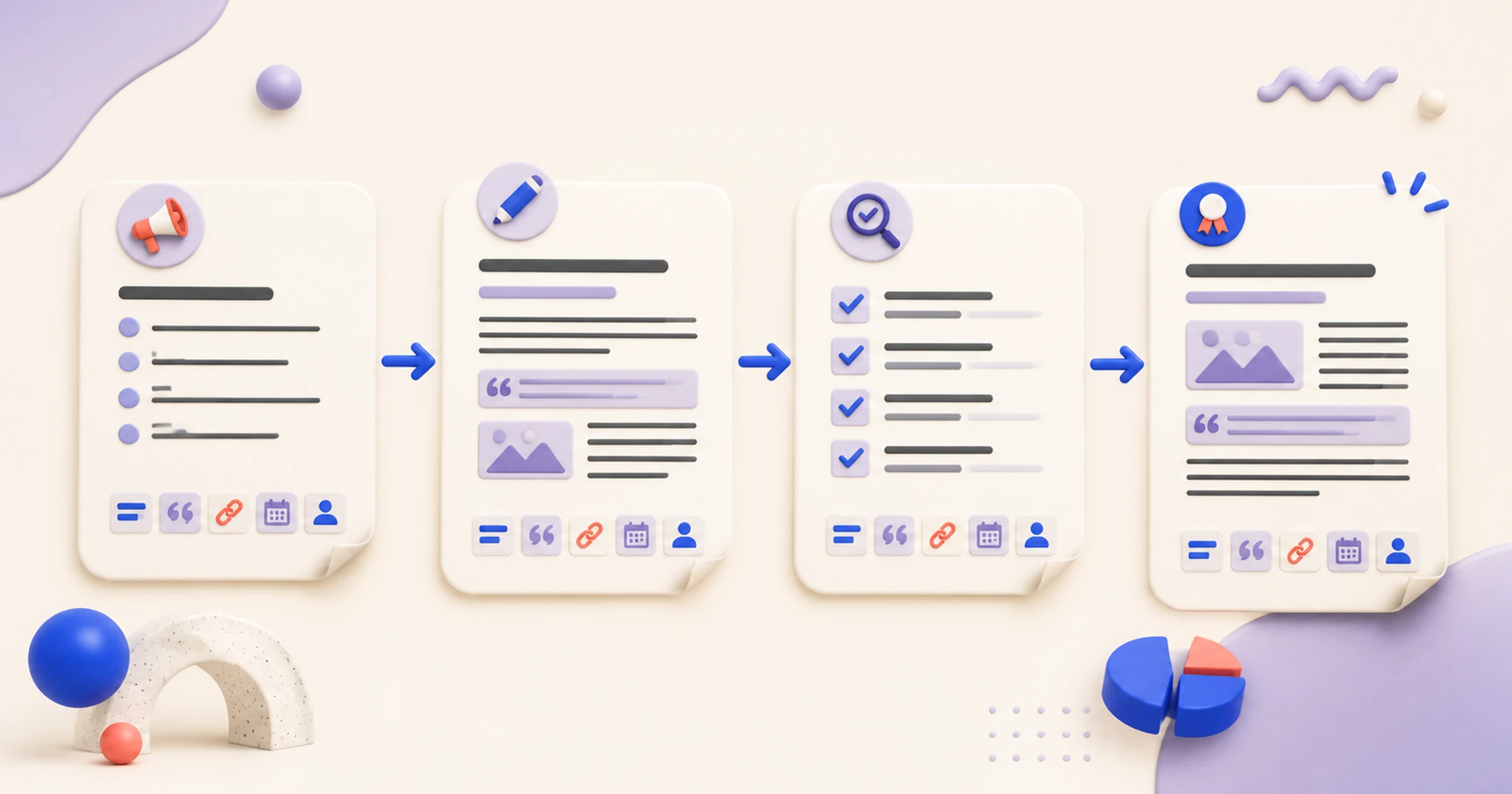
- How to write a press release in 8 steps
- Annotated press release example
- Formats for common announcements
- Headline, lead, and quote examples
- Editing and approval checklist
- Draft press-release materials in AFFiNE
- Frequently asked questions
What is a press release?
A press release is an organization-issued news document that gives journalists and other readers the verified facts of an announcement in a familiar order. A press release template is the reusable structure for that document, helping a writer cover the headline, dateline, lead, evidence, quotation, boilerplate, and contact details without starting from a blank page.
The structure is a convention, not a law. Public Relations Student Society of America guidance identifies common elements such as contact information, headline, dateline, body, boilerplate, and closing notation. PR Newswire's writing guide likewise recommends a newsworthy headline, essential news questions near the beginning, accurate support, a boilerplate, and a media contact.
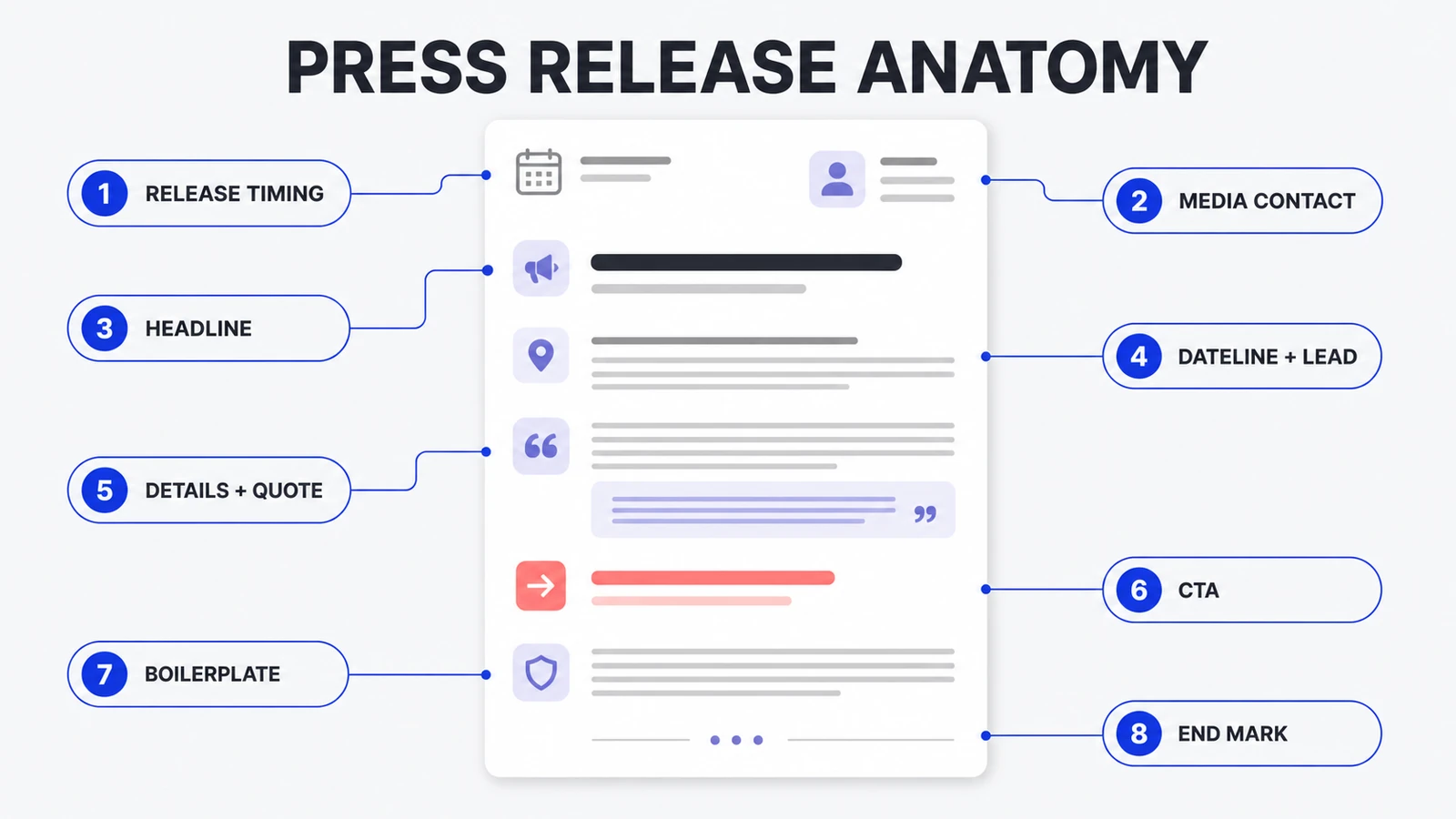
Copy-and-paste press release template
Copy the block into your workspace. Keep brackets until an owner supplies or approves the information; remove instructions before distribution.
[FOR IMMEDIATE RELEASE]
or
[EMBARGOED UNTIL: Month DD, YYYY, time, time zone]

Media contact:
[Full name]
[Role, organization]
[Work email]
[Work phone, if monitored]

[SPECIFIC HEADLINE THAT STATES THE NEWS]
[Optional subheadline that adds one useful detail]

[CITY, State, Month DD, YYYY] — [Organization name] today announced
[what happened]. [Explain who is affected and why the news matters now.]

[Add the strongest verified supporting detail: availability, scope,
date, location, evidence, or a clearly labeled limitation.]

“[Approved quotation that adds interpretation, consequence, or a human
perspective rather than repeating the lead],” said [Full name], [title]
at [organization].

[Add concise background and any second supporting fact. Attribute data
to its source and link to a useful page with descriptive anchor text.]

[CTA / NEXT STEP: Tell the relevant reader where to learn more, register,
view the materials, or contact the media representative.]

About [Organization name]
[Two or three factual sentences explaining what the organization does,
whom it serves, and where readers can verify more information.]

Media contact:
[Full name, role, email, phone if appropriate]

###
For regulated, financially material, medical, legal, or safety-related news, obtain professional review. This template offers no compliance guarantee. US public companies should consult counsel and current SEC Regulation FD guidance.
What each section should accomplish
| Section | Its job in the release | Review question |
|---|---|---|
| Release timing | States whether the information may be used now or after an explicit date, time, and time zone | Could two readers interpret the timing differently? |
| Media contact | Gives a monitored route for factual follow-up | Will this person be available, and are the details correct? |
| Headline | States the verifiable news in a specific subject-verb frame | Does it say what changed without hype? |
| Optional subheadline | Adds context that would overload the headline | Does it contribute a new fact rather than repeat the title? |
| Dateline and lead | Establishes place/date and answers the most important who, what, when, where, and why | Can a busy reader understand the announcement from this paragraph alone? |
| Supporting details | Supplies evidence, scope, background, links, and limitations | Can every material claim be traced to an owner or source? |
| Quote | Adds interpretation, consequence, or credible human perspective | Is it approved, attributable, and different from the lead? |
| CTA / next step | Points the relevant reader to a useful action or source | Is the destination live and the action proportionate? |
| Boilerplate | Gives stable, factual organization context | Is it current, short, and free of unsupported superlatives? |
| End mark | Shows that the formal release has ended | Is ### placed after the final release content? |
How to write a press release in 8 steps
1. Decide whether the announcement is newsworthy
Write one sentence describing what is new and one explaining who should care. An update, partnership, event, finding, leadership change, or milestone may qualify when it has a real date and consequence. “We want attention” is not a news angle.
2. Define the reader and desired next step
Name the relevant beat, community, customer group, donor audience, or local stakeholder. Choose one practical action: view source materials, register, or contact the media representative.
3. Build a verified fact sheet
Collect official names, roles, dates, time zones, locations, links, numbers, methodology notes, and constraints. Mark estimates and pending approvals. Store the source beside each fact.
4. Draft the headline and lead
Use a specific subject, an active verb, and the actual change. Write a lead that stands on its own. PR Newswire advises writers not to bury the lede and to answer the central news questions quickly.
5. Add evidence in descending order of importance
Put the strongest verified detail next: essential facts first, supporting context later. A practical writer recommendation is roughly 300–500 words when the announcement fits that range, but accuracy and required disclosures matter more than a rigid count.
6. Write and approve a useful quote
Draft a quote after the facts stabilize. It should explain why the change matters, what was learned, or what happens next. Record the speaker's approval; never invent a quotation for a real person.
7. Add the boilerplate, contact, and next step
Verify the boilerplate against current public facts, test every link, and confirm that the media contact can respond during the release window.
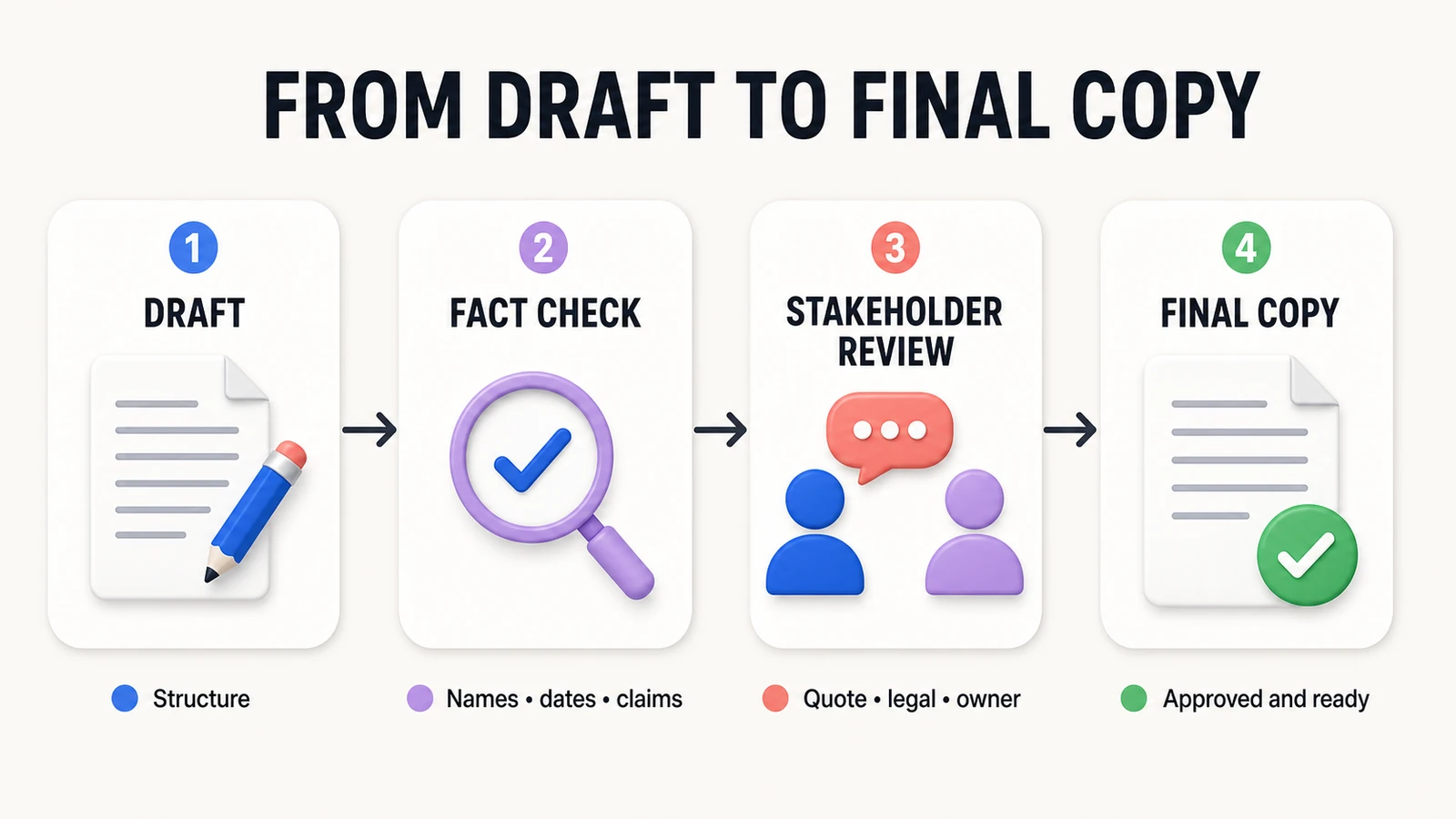
8. Run internal review and a final fact check
Ask subject-matter, quote, brand, and legal or regulatory owners to review what they own. Resolve comments, compare the clean copy with the fact sheet, and reconfirm timing.
Annotated press release example
Everything below—the organization, people, event, quote, and numbers—is fictional example content, not an AFFiNE claim or customer result.
FOR IMMEDIATE RELEASE
[release timing]Media contact: Jamie Ortiz, Communications Lead, [email protected]
[owner]Harborlight Learning Lab Opens Free Saturday Repair Workshops
[specific headline]Six-week pilot gives local high school students supervised practice with small electronics
[new context]PORT ALDER, Ore., Sept. 12, 2026 — Harborlight Learning Lab, a fictional nonprofit, will open six weeks of free Saturday electronics-repair workshops for students ages 14–18 beginning Oct. 3. The pilot gives 48 participants supervised practice diagnosing donated devices.
[dateline + lead]Registration opens Sept. 15 on the fictional program page. Each three-hour session will pair 12 students with volunteer instructors.
[supporting facts]“The goal is not to promise that every device can be saved; it is to help students ask better diagnostic questions and practice safely with guidance,” said Lena Brooks, fictional program director at Harborlight Learning Lab.
[approved-style quote that adds meaning]The pilot will track attendance, completed safety checks, and devices assessed. Results will be reviewed before any expansion decision.
[evidence + limitation]Next step: View the fictional schedule and registration requirements at example.org/repair-workshops.
[CTA]About Harborlight Learning Lab
Harborlight Learning Lab is a fictional nonprofit created solely for this example. It does not represent a real organization, program, partnership, or result.[boilerplate]Media contact: Jamie Ortiz, [email protected]
###[contact + end mark]
The example exposes the audience, dates, capacity, limitation, and next step. Its quote adds interpretation without promising impact.
Press release formats for common announcements
Keep the core template and change the evidence fields.
| Announcement | Lead with | Add or change | Avoid |
|---|---|---|---|
| Product launch or update | What is available, for whom, and on what date | Eligibility, availability, verified capabilities, pricing source, demo or documentation link | “Revolutionary” claims or invented customer outcomes |
| Partnership | What the organizations will do together | Each party's role, scope, start date, approved quotes, and what is not included | Implying endorsement, exclusivity, or results beyond the agreement |
| Event | Event purpose, date, location, and intended audience | Registration deadline, capacity, accessibility, speakers, media access, cancellation contact | Hiding fees, eligibility, or time zone |
| Company milestone | The measured change and its time period | Baseline, methodology, source, significance, and limitations | Treating a vanity metric as business or social impact |
For a product update: “Fictional Northbank Tools adds offline form review for field inspectors on Oct. 6.” For a partnership/event: “Fictional nonprofits Cedar House and Open Gate will host four free tenant-rights clinics in November.” Both are specific without pretending results are proven.
Headline, lead, and quote examples: weak vs. stronger
| Element | Weak | Stronger | Why it is stronger |
|---|---|---|---|
| Headline | “Exciting Company Announces Amazing Innovation” | “Fictional Cedar Works Opens Tool-Lending Pilot for 200 County Residents” | Names the actor, action, program, and defined audience without hype |
| Lead | “We are thrilled to share news that will change everything.” | “Cedar Works, a fictional nonprofit, will open a 12-week tool-lending pilot in Port Alder on Oct. 5 for up to 200 registered residents.” | Answers the core news questions and labels example facts |
| Quote | “We could not be more excited about this game-changing launch.” | “The pilot will test whether shared equipment reduces the upfront cost of four common home repairs before we decide whether to expand,” said the fictional program director. | Adds rationale, a testable purpose, and a limitation |
These are writer recommendations, not mandatory formulas. Match verified facts and the intended channel's standards.
Editing and approval checklist
- Facts: Match every claim and number to a source or accountable owner; label estimates and examples.
- Names and roles: Confirm spelling, title, organization, and quote attribution with the person or authorized representative.
- Dates and timing: Verify the event date, release date, embargo date, clock time, time zone, and daylight-saving implications.
- Links: Open every URL, use descriptive anchor text, and confirm that access does not require an undisclosed login.
- Claims: Remove unsupported superlatives, guarantees, causal claims, and comparisons.
- Quote approval: Record who approved the final wording and when.
- Contact: Test the email and phone route and confirm coverage during the release window.
- Review ownership: Identify who owns subject matter, brand, legal/regulatory, and final release approval.
- Mobile readability: Use short paragraphs, useful subheads, plain links, and a clean text version.
- Final copy: Remove placeholders, comments, tracked changes, internal filenames, and duplicated contact blocks unless the chosen format intentionally uses both.
How to draft and organize press-release materials in AFFiNE
Use AFFiNE Page Docs for the release, fact sheet, approvals, and source links. Page Docs support blocks, tables, links, images, and real-time team collaboration in cloud or self-hosted team workspaces. Keep clean copy separate from notes so unresolved comments cannot look approved.
Start with this article or browse the AFFiNE template gallery. A content calendar template can track timing, owners, review status, assets, and follow-up. A meeting notes template can preserve decisions and owners beside the draft.
AFFiNE is a drafting and knowledge workspace. It does not provide press distribution, a journalist database, guaranteed coverage, media monitoring, or an email-outreach service. Export or hand off the approved final copy through the channel your communications owner has selected.
Frequently asked questions
What should be included in a press release template?
Include release timing, a monitored media contact, headline, optional subheadline, dateline, lead, supporting facts, an approved quotation, a clear next step, an organization boilerplate, and an end mark. Some channels may request additional fields or multimedia, so verify the requirements of the intended recipient or distribution service before sending.
How long should a press release be?
Many routine announcements can fit in roughly 300–500 words, but that is an editing target rather than a universal rule. Use the shortest length that states the news, evidence, context, quote, next step, boilerplate, and contact accurately. Regulated or technically complex announcements may need professional review and additional required language.
Is a subheadline required in a press release?
No. A subheadline is optional. Use one when it can add a specific audience, date, location, result, or limitation without making the headline unwieldy. Remove it if it merely repeats the headline or introduces promotional language. The headline and lead should still communicate the essential news when read without it.
What is a dateline in a press release?
A dateline is the place-and-date marker at the start of the lead, usually identifying the city, relevant state or country, and release date. Its exact punctuation and abbreviations can vary by house style or distribution channel. Check the recipient's current rules instead of assuming one vendor's convention is legally required.
Do press releases have to follow AP style?
AP-style conventions are widely used in US news writing and can make copy easier for journalists to scan, but a press release is not invalid simply because it follows another documented house style. Use clear US English, keep names and dates consistent, and follow the current requirements of your organization, counsel, outlet, or distribution channel.
Does a press release guarantee media coverage?
No. A press release supplies an organization-controlled account of news; it does not require a journalist to respond, verify the claim positively, or publish a story. Newsworthiness, timing, relevance, evidence, relationships, and editorial judgment all affect coverage. Treat distribution and earned-media results as separate from drafting a factual release.
Turn the template into a review-ready release
A useful press release template removes structural guesswork, not editorial judgment. Fill it from a verified fact sheet, assign every quote and claim, and run the timing, link, contact, and approval checks. Once accurate and newsworthy, hand it to the distribution owner.