Progress Report: How to Write One + Free Template
A progress report is a recurring document that explains what changed during a defined period: what the team completed, how results compare with the plan, what is blocking progress, and what happens next. It gives stakeholders enough evidence to understand movement toward an objective and act without reading every task or message.
TL;DR
- Start with the objective, owner, reporting period, and a two- or three-sentence summary.
- Use PPP—Progress, Plans, Problems—for a clear narrative update.
- Add RAG status—Red, Amber, Green—when readers need project health at a glance.
- Report outcomes and movement against a baseline, not just activity.
- End with named owners, dates, decisions needed, and the next reporting date.
- Copy the weekly progress report template below and adapt its detail to your audience.
Table of contents
- What is a progress report?
- What should a progress report include?
- Progress report vs. project status report
- Two useful models: PPP and RAG
- How to write a progress report in seven steps
- Free weekly progress report template
- Filled progress report example
- Common progress report mistakes
- Create connected progress reports in AFFiNE
- Frequently asked questions
What is a progress report?
A progress report records movement toward a goal over a period. It connects the plan with completed work, measurable results, obstacles, and scheduled next steps. Reports may be daily, weekly, monthly, milestone-based, or required by contract or grant.
The audience determines detail. A delivery team may need task-level blockers and dependencies; a sponsor may need only overall health, milestone movement, budget implications, and escalations.
In funded work, a progress report can be a compliance document. Grants.gov explains that US federal grant recipients may submit Performance Progress Reports containing financial and quantitative impact data. Always use the required form when a funder, customer, school, or agency provides one.
What should a progress report include?
| Section | What to include | Question it answers |
|---|---|---|
| Report details | Project, owner, date, reporting period, audience | What does this update cover? |
| Objective | Desired outcome, milestone, or deliverable | What are we trying to achieve? |
| Summary | Overall movement, most important result, main concern | What should a busy reader know first? |
| Completed work | Finished deliverables and validated outcomes | What changed since the last report? |
| Metrics | Baseline, target, current value, and trend | Are results moving toward the goal? |
| Problems and risks | Blocker, impact, mitigation, and help needed | What could stop or delay progress? |
| Plans and next steps | Action, owner, due date, and dependency | What happens next, and who owns it? |
| Decisions needed | Specific approval or choice, with a deadline | Where must a reader act? |
The International Telecommunication Union progress report template includes the reporting period, project manager, preparer and date, expected results, KPIs, targets, percentage achieved, activity status, deadlines, and explanations for deviations. These fields connect the plan with its evidence.
Progress report vs. project status report
People often use progress report and project status report interchangeably. The practical distinction is time orientation: a progress report emphasizes movement across a period, while a status report emphasizes the project's condition at a point in time.
| Dimension | Progress report | Project status report |
|---|---|---|
| Primary question | What changed, and are we advancing? | Where does the project stand now? |
| Time focus | Since the last report or against a baseline | Current snapshot |
| Typical evidence | Completed work, metric movement, milestone change | Health, schedule, budget, scope, risks |
| Best use | Weekly or monthly learning and accountability | Executive scan, portfolio review, escalation |
| Common format | Narrative plus tables | Dashboard, summary, or traffic-light view |
Asana's comparison notes that many teams combine both. Use the label your organization understands, state the reporting period, and include both change and current health when needed.
Two useful models: PPP and RAG
PPP structures the update; RAG compresses health into a signal. They work well together.
The PPP method: Progress, Plans, Problems
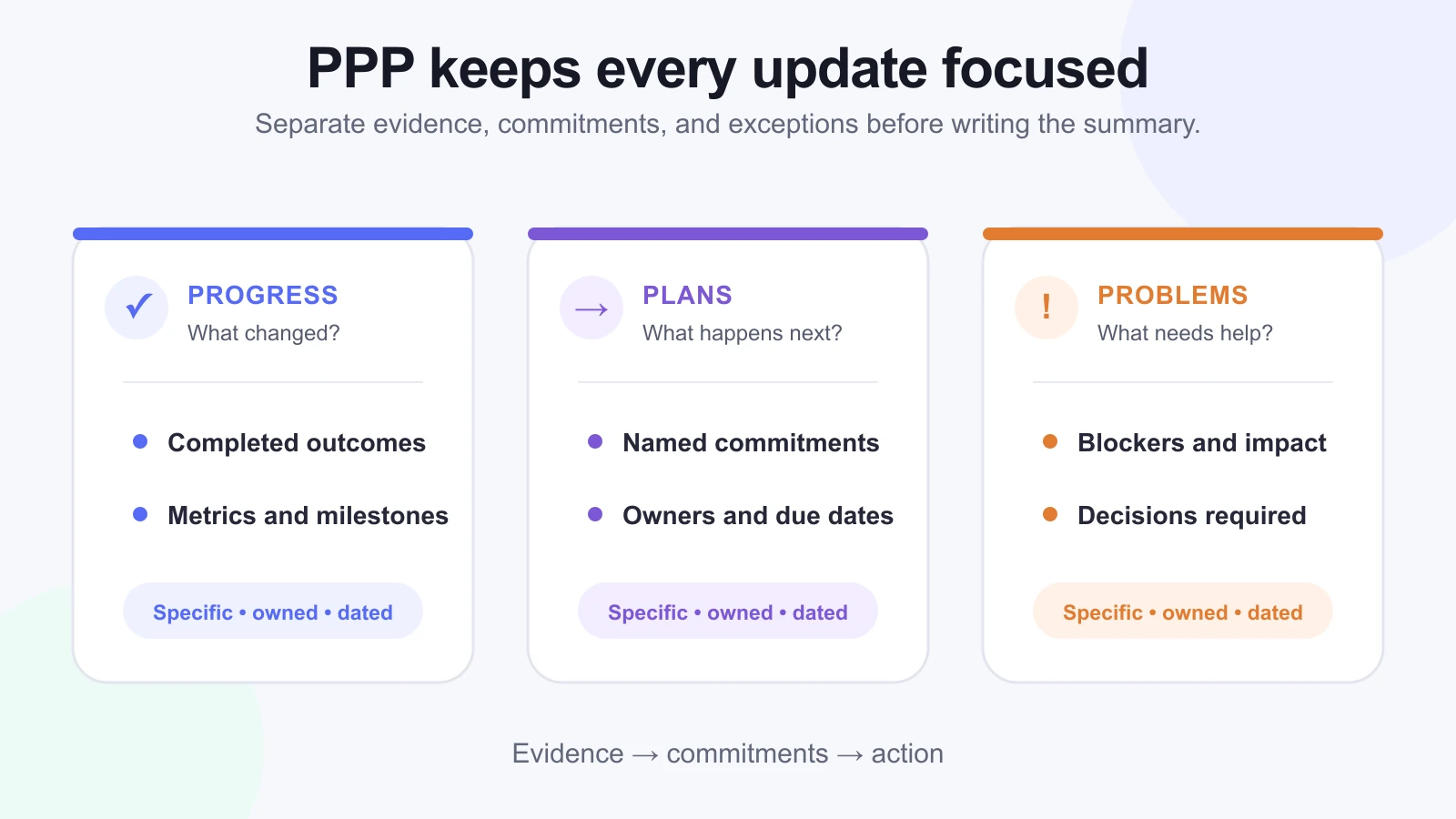
PPP is a compact framework for recurring reports:
- Progress: What was completed or measurably advanced?
- Plans: What will the team deliver or validate next?
- Problems: What is blocked, at risk, or awaiting a decision?
Write Progress as evidence, not effort. “Held three workshops” is activity; “Approved the new onboarding flow after three stakeholder workshops” is an outcome. If validation is pending, say so.
Write Plans as commitments with owners and dates. “Jordan will validate checkout event coverage by August 8” is better than “Work on analytics.”
Write Problems as actionable exceptions. Include the impact and help required: “Legal review is holding the vendor pilot; approval is needed by August 7 to protect the August 12 start.”
The RAG status model: Red, Amber, Green
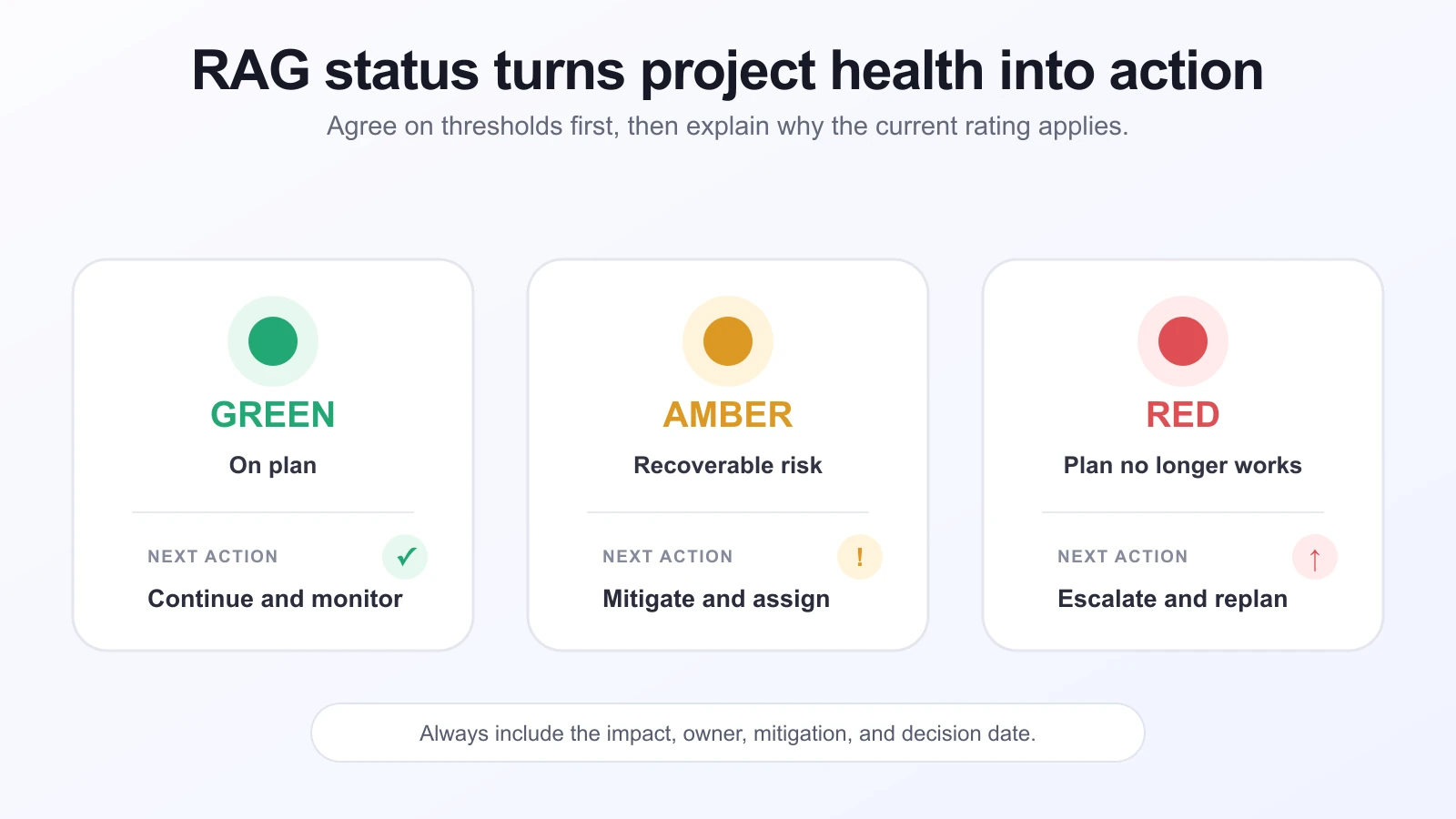
RAG gives readers a fast health signal:
| Status | Practical project meaning | Required follow-up |
|---|---|---|
| Green | Work is on plan; no unresolved issue currently threatens the objective or milestone | Continue and monitor |
| Amber | A deviation or material risk needs action, but the objective remains recoverable | Name mitigation, owner, and decision date |
| Red | The objective or milestone is not achievable under the current plan | Escalate and replan or change scope |
Agree on thresholds before reporting. As a public example, the UK's Environment Agency defines RAG performance as green for on track, amber when improvement is required, and red when significant improvement is required.
Define which schedule, budget, quality, or risk threshold triggers each color. Add one sentence explaining the current rating.
How to write a progress report in seven steps
1. Identify the reader and the decision
A team lead needs operational detail; an executive needs consequences and choices.
2. Set the reporting period and cadence
Put the covered dates beside the report date. Choose weekly updates for active delivery, monthly updates for slower initiatives, or milestone-based reports for phased work. Keep the structure consistent.
3. Restate the objective and baseline
State success in one or two sentences, including the baseline, target, deadline, or acceptance criterion. If the objective is unclear, revisit the project planning phase deliverables first.
4. Collect evidence before writing
Review the plan, tracker, milestones, budget, quality checks, feedback, and previous report. Confirm values with owners. See how to track project progress to choose useful evidence.
5. Draft Progress, Plans, and Problems
Use PPP headings to separate outcomes, commitments, and exceptions. For multiweek work, describe new movement instead of repeating the task name.
6. Add metrics and RAG status
Compare current values with a baseline or target and label estimates. Apply the agreed RAG threshold. If schedule is green but quality is red, show both and let the most material risk determine overall health.
7. Write the summary last, then assign actions
Summarize overall movement, the best result, biggest risk, and decision needed in two or three sentences. Assign every next step to an owner and date, then verify names, numbers, links, and dates.
The PMI Educational Foundation status report template uses a similarly practical set of fields: current status, activities completed, activities planned, issues and resolutions, scope changes, and problems or recommendations.
Free weekly progress report template
Copy this Markdown into your workspace. For a broader system, explore these free project tracker templates.
# Weekly Progress Report: [Project name]

**Owner:** [Name and role]
**Report date:** [Month DD, YYYY]
**Reporting period:** [Start date–end date]
**Audience:** [Team, sponsor, client, or department]
**Overall status:** [Green / Amber / Red] — [One-sentence reason]

## Objective
[State the desired outcome, target, and deadline.]

## Summary
[In 2–3 sentences, state overall movement, the most important result,
the main risk, and any decision needed.]

## Progress: completed this period
- [Completed outcome or deliverable, with evidence]
- [Milestone reached or metric changed]
- [Decision made or validation completed]

## Metrics
| Metric | Baseline | Target | Current | Change / note |
|---|---:|---:|---:|---|
| [Metric 1] | [Value] | [Value] | [Value] | [Trend or context] |
| [Metric 2] | [Value] | [Value] | [Value] | [Trend or context] |

## Plans: next reporting period
| Next step | Owner | Due date | Dependency / success check |
|---|---|---|---|
| [Action] | [Name] | [Date] | [Dependency or acceptance criterion] |

## Problems, risks, and blockers
| Problem or risk | Impact | Mitigation / help needed | Owner | Decision date |
|---|---|---|---|---|
| [Issue] | [Schedule, scope, cost, or quality impact] | [Action or ask] | [Name] | [Date] |

## Decisions needed
- [Decision] — **Decision owner:** [Name] — **Needed by:** [Date]

## Upcoming milestones
- [Milestone] — [Date] — [On track / At risk / Off track]

**Next report date:** [Month DD, YYYY]
Filled progress report example
The numbers below are illustrative, not AFFiNE product data or an industry benchmark.
Weekly Progress Report: Help Center Search Improvement
Owner: Maya Patel, Product Operations Lead
Report date: August 3, 2026
Reporting period: July 27–August 2, 2026
Overall status: Amber — Search quality is improving, but legal review may delay the production experiment scheduled for August 12.
Objective
Reduce the zero-result search rate from an 18% baseline to 10% or lower by August 31, 2026, while maintaining the existing search-response quality checks.
Summary
The zero-result rate reached 13.2% in testing, and the query-mapping milestone is complete. Approval of the vendor's data-retention language is needed by August 7 to protect the production experiment.
Progress: completed this period
- Categorized 1,240 zero-result queries by intent and content gap.
- Added 61 of 75 planned synonym rules; 52 passed editorial review.
- Documented the production rollback check with Engineering and Support.
Metrics
| Metric | Baseline | Target | Current | Change / note |
|---|---|---|---|---|
| Zero-result search rate | 18.0% | ≤10.0% | 13.2% | Down 4.8 percentage points in test |
| Queries categorized | 0 | 1,200 | 1,240 | Milestone complete |
| Synonym rules approved | 0 | 75 | 52 | 69% of target |
| Quality checks passed | 0 | 100% | 86% | 6 cases require revision |
Plans: next reporting period
| Next step | Owner | Due date | Dependency / success check |
|---|---|---|---|
| Revise six failed synonym cases | Elena Ruiz | August 5 | All quality checks pass |
| Approve data-retention language | Marcus Lee | August 7 | Legal review complete |
| Run production-readiness review | Maya Patel | August 8 | Legal approval and rollback check |
Problems, risks, and blockers
| Problem or risk | Impact | Mitigation / help needed | Owner | Decision date |
|---|---|---|---|---|
| Vendor data-retention clause is still under legal review | Could move the August 12 experiment and compress the measurement window | Legal to approve the current clause or provide required edits | Marcus Lee | August 7 |
| Six synonym cases reduced result relevance | Could improve coverage while lowering quality | Revise rules and rerun the documented test set | Elena Ruiz | August 5 |
Decisions needed
- Approve the vendor clause or return final edits — Decision owner: Marcus Lee — Needed by: August 7.
Upcoming milestones
- Production-readiness review — August 8 — At risk
- Controlled production experiment — August 12 — At risk
Next report date: August 10, 2026
Common progress report mistakes
Use this checklist before sending:
- Reporting activity instead of outcomes. State what was completed, changed, tested, or learned.
- Leaving out the reporting period. Readers cannot judge movement without a defined time window.
- Using percentages without a baseline. State the comparison and calculation.
- Hiding blockers behind vague language. Name the impact, owner, mitigation, and decision date.
- Assigning actions to a team instead of a person. Every critical next step needs one accountable owner.
- Calling everything green. Apply written RAG thresholds consistently, even when the update is uncomfortable.
- Copying the task list. Summarize work affecting objectives, milestones, risks, or decisions.
- Changing the format every cycle. A stable structure makes changes easier to compare.
- Ending without an ask. If a decision is needed, state who must decide and by when.
- Sending before verification. Check dates, owners, metric definitions, links, and claims.
Create connected progress reports in AFFiNE
A progress report works best when the update and project context stay connected. In AFFiNE Page mode, teams can create a reusable report with headings, tables, bullets, and linked supporting material. Duplicate it each period for easier comparison.
Use the AFFiNE whiteboard when a blocker needs visual context. Map milestones, owners, dependencies, and risks on the canvas, then keep the concise explanation in the report. AFFiNE's product pages verify rich page blocks and tables, plus movement between structured pages and the edgeless whiteboard.
A practical workflow:
- Create a Page report from the weekly template.
- Link the objective and metrics to the relevant planning material.
- Use the whiteboard to show a dependency path or milestone sequence that would be hard to explain in prose.
- Return to the Page and state the decision, owner, and date.
Keep evidence, plans, and visual context connected while the update stays scannable.
Frequently asked questions
What is the main purpose of a progress report?
The main purpose of a progress report is to show movement toward a defined objective during a specific period. It tells readers what was completed, how results compare with the plan, what is at risk, and what happens next. It should also surface decisions or help needed from stakeholders.
How do you start a progress report?
Start with the project name, owner, report date, reporting period, and objective. Then write a short summary stating the overall health, most important accomplishment, biggest blocker, and any decision needed. Draft that summary after the detailed sections so it reflects the evidence accurately.
What are the three parts of a PPP progress report?
PPP stands for Progress, Plans, and Problems. Progress lists completed outcomes or measurable movement. Plans identifies the next commitments, owners, and due dates. Problems explains blockers, risks, or decisions that could affect delivery. Together, the three sections make a recurring update concise, comparable, and actionable.
How often should a progress report be written?
Choose a cadence based on the speed and risk of the work. Weekly reports suit active projects with frequent decisions; monthly reports suit slower initiatives and leadership reviews. Daily updates should be brief and reserved for fast-moving work. Contractual, academic, or grant reporting must follow the required schedule.
How long should a progress report be?
A routine weekly progress report should be only as long as needed to explain meaningful change, current risk, and next actions—often one or two scannable pages. Complex client, grant, or program reports may be longer because they require financial, compliance, or evidence sections. Prioritize decisions over exhaustive activity logs.
Turn reporting into the next clear action
A strong progress report connects the objective, evidence, current health, and next commitment. Use PPP to tell the story, RAG to show urgency, and consistent metrics to prove movement. Start with the template, keep the reporting period explicit, and make every blocker or next step answerable by an owner and date.