How to Write an Elevator Pitch: 6 Examples + Template
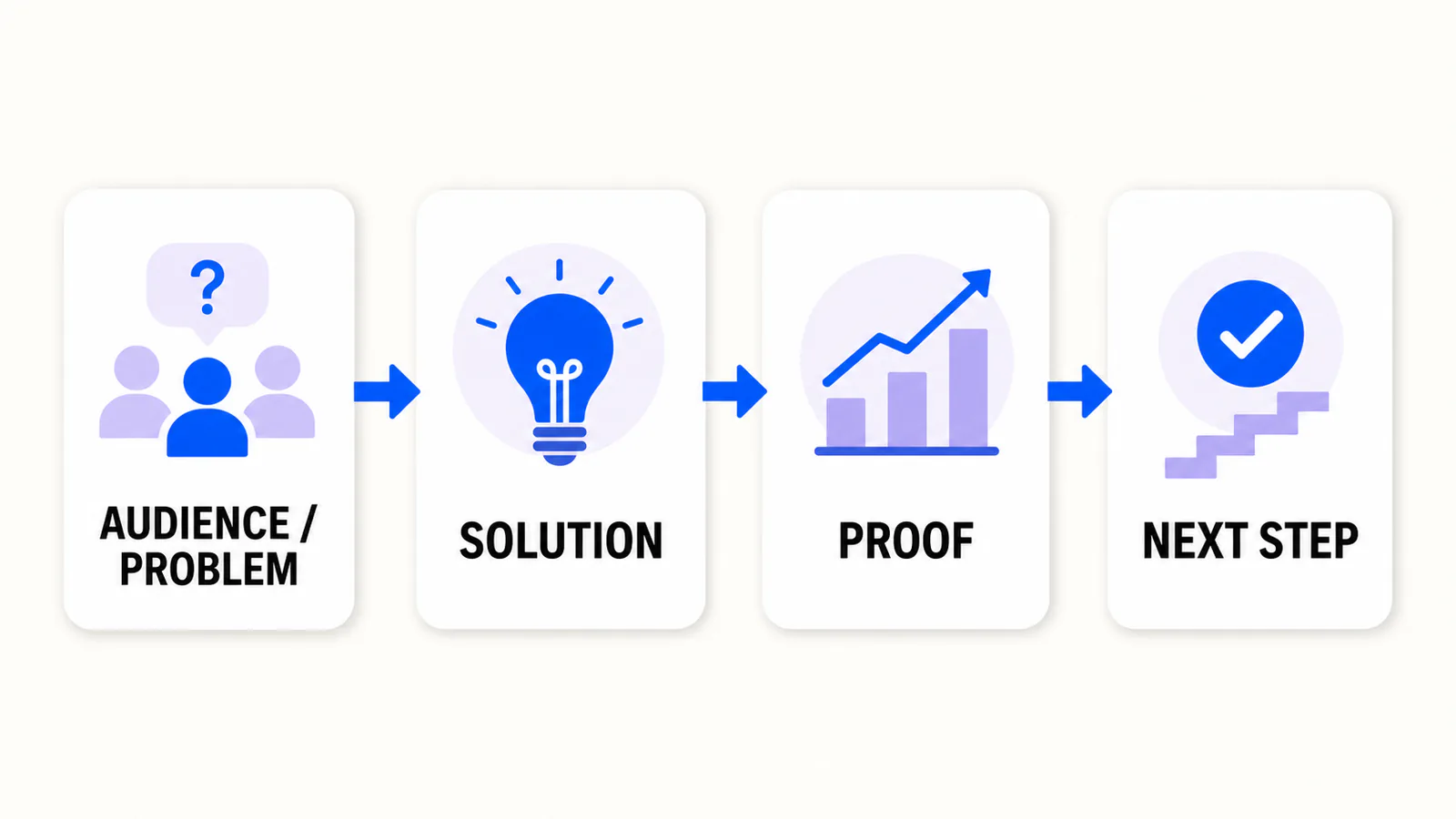
An elevator pitch is a short, audience-specific introduction that explains what you do, why it matters, and what should happen next. Use this formula: audience or problem + solution + proof + next step. A strong pitch is not a compressed autobiography or a hard sell. It is a clear opening designed to earn a relevant follow-up conversation.
This guide is for job seekers, students, founders, salespeople, freelancers, and internal leaders. It covers spoken pitches, not full decks or proposals.
TL;DR
- Lead with the listener's situation, not your entire background.
- Explain one useful solution in plain English.
- Add one credible proof point, such as a result, project, credential, or customer signal.
- End with a specific, low-friction next step.
- Prepare 15-, 30-, and 60-second versions, then practice until each sounds conversational.
Table of contents
- What is an elevator pitch?
- The four-part elevator pitch framework
- How to write an elevator pitch in six steps
- 15-second, 30-second, and 60-second pitches
- Fill-in-the-blank elevator pitch template
- Six elevator pitch examples
- Before-and-after editing example
- Delivery checklist
- Frequently asked questions
What is an elevator pitch?
An elevator pitch is a brief spoken introduction that helps someone understand who you are, the value you offer, and why continuing the conversation could be worthwhile. Use it in networking, interviews, sales conversations, meetings, or any situation where attention is limited.
Princeton University's Center for Career Development describes it as a 30–60 second professional introduction. Harvard Catalyst similarly frames a pitch as a compelling introduction covering who you are, what you do, and why your work matters.
The real constraint is attention, not location. Give the listener enough context to ask a useful question—not every detail they might eventually need.
The four-part elevator pitch framework
Use four parts in this order. The framework works for a person, product, service, startup, or internal initiative.
| Part | Question to answer | What to include | Avoid |
|---|---|---|---|
| 1. Audience/problem | Who is this for, and what matters to them? | A recognizable goal, friction, or unmet need | A generic opening that could address anyone |
| 2. Solution | What do you do about it? | Your role, offer, idea, or method in plain language | A feature dump or long job history |
| 3. Proof | Why should the listener believe you? | One relevant result, project, credential, demonstration, or customer signal | Unsupported superlatives such as “best” or “revolutionary” |
| 4. Next step | What should happen now? | One question, introduction, short meeting, review, or pilot | “Let me know” or a large commitment too early |
The “solution” may be your skills, a product, a service, or a proposed workflow. The logic stays the same: relevance first, evidence next, action last.
How to write an elevator pitch in six steps
1. Choose one audience and one outcome
Write down who will hear the pitch and what you want. “A hiring manager for healthcare operations” is more useful than “employers.” “Permission to run a six-week pilot” is clearer than “support.”
Audience choice changes what counts as relevant. The National Institutes of Health recommends understanding the audience before writing in its plain-language guidance.
2. Name the problem in the listener's language
Describe one concrete tension: missed follow-ups, slow handoffs, confusing reports, or an unmet need. Use words the listener would use. If your opening needs three definitions, it is not ready.
The problem need not be negative. A student can lead with an area to explore; a freelancer can name a growth goal. Establish a shared point of relevance.
3. Explain your solution in one sentence
Say what you do and how it helps. Prefer concrete verbs: analyze, design, reduce, connect, organize, build, or teach.
“I improve the handoff between sales and onboarding” is easier to grasp than “I provide cross-functional revenue enablement solutions.” If a technical term is essential, explain it in familiar language. The National Institute on Aging likewise advises communicators to avoid jargon and unexplained acronyms.
4. Add one proof point
Proof gives the listener a reason to believe your claim. Choose one relevant form:
- measurable result;
- completed project or prototype;
- relevant credential or responsibility;
- customer usage or feedback;
- concise example of the problem solved.
Use only figures you can defend. Early-career evidence can be coursework, volunteer work, a portfolio project, or a demonstration—not a fabricated result.
5. Ask for a realistic next step
Match the ask to the relationship. A first meeting may justify a question, referral, portfolio, short call, or small pilot—not an immediate purchase or job offer.
The Centers for Disease Control and Prevention's Clear Communication Index recommends one main message and a clear call to action. Apply the same discipline here: end with one action, not three competing requests.
6. Cut, time, and say it aloud
Remove any sentence that does not improve relevance, understanding, credibility, or momentum. Time the pitch at your natural pace; spoken sentences need simple syntax and room to breathe.
Record one take and note where you sound rushed or vague. Harvard Catalyst recommends recording and self-assessing your delivery. Practice the ideas rather than every syllable.
15-second, 30-second, and 60-second pitches
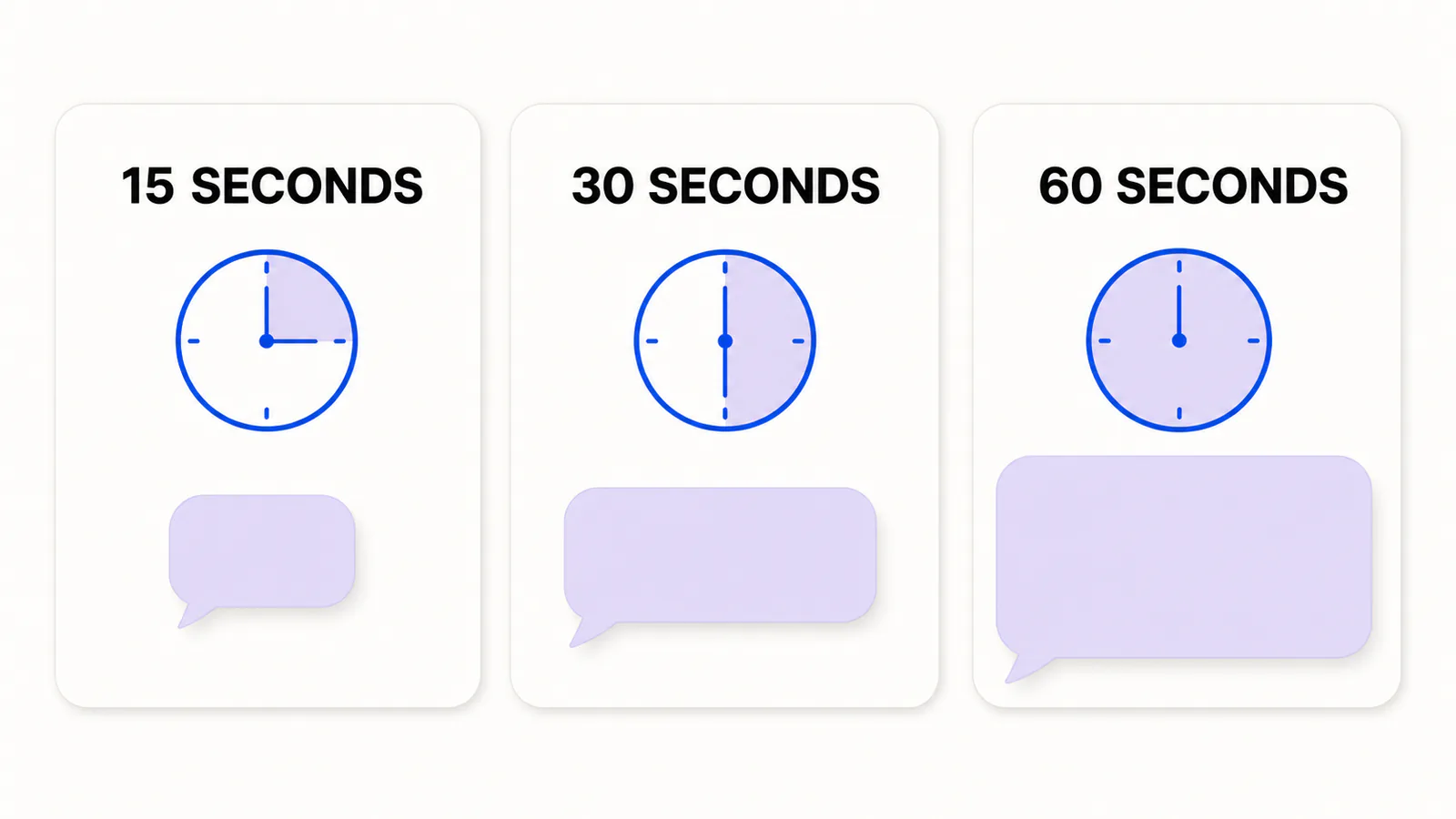
Prepare three versions so you can adapt to the moment. The word ranges below are practical starting points, not rigid rules.
| Version | Approximate length | Best use | Include |
|---|---|---|---|
| 15 seconds | 30–40 words | Quick introduction, busy event, opening round | Audience/problem, solution, simple question |
| 30 seconds | 60–80 words | Networking, interview opener, prospecting | All four parts with one concise proof point |
| 60 seconds | 120–150 words | Scheduled introduction, pitch event, stakeholder meeting | Context, solution, proof, differentiation, focused ask |
A 15-second elevator pitch
Use the shortest version to earn more conversation: “I help independent clinics reduce appointment gaps through simpler patient follow-up. One practice filled 12 empty slots last month. How do you handle cancellations?”
A 30-second elevator pitch
Add enough evidence to be credible, but keep one main idea. This is the most versatile version for networking.
A 60-second elevator pitch
Use the extra time for context or one brief story—not a second pitch. If the listener asks a question, stop and converse.
Fill-in-the-blank elevator pitch template
I work with [specific audience] who need to [goal] but often struggle with [problem]. I [what you do or offer] so they can [valuable outcome]. Recently, [relevant proof point]. Would you be open to [specific next step]?
For a personal introduction, use this variation:
I'm a [role, field, or area of study] focused on [problem or domain]. I use [two relevant skills] to [outcome]. In [project or role], I [specific evidence]. I'm now looking to [goal]. Could I [focused next step]?
Treat the template as scaffolding. Change the order when the setting calls for it, and replace formal phrases with language you would actually say.
Six elevator pitch examples
The following examples are original and illustrative. Their metrics are fictional, so replace every number with evidence you can verify.
1. Job seeker elevator pitch
“I'm an operations coordinator who fixes process gaps that create expensive mistakes. I redesigned our invoice review checklist and helped reduce correction requests by 32% in one quarter. I'm looking for an operations analyst role combining process mapping with implementation. What problems should your next hire solve first?”
2. Student elevator pitch
“I'm a junior studying environmental economics and how cities can make public transportation easier to use. I analyzed 50,000 anonymized trip records and found two time windows with unusually high missed connections. I'm seeking a summer internship applying data analysis to transportation planning. May I send you the two-page project summary?”
3. Founder elevator pitch
“Small landscaping companies prepare quotes after a long day in the field, so promising leads wait—or get lost. Our mobile workflow turns a crew lead's voice notes and photos into a review-ready estimate. In a trial with 14 businesses, teams sent quotes 28% faster. We're seeking three owner-operators for a four-week pilot. Would that be relevant?”
4. Salesperson elevator pitch
“Revenue operations teams often track renewals across spreadsheets, inboxes, and CRM notes, which makes the weekly risk review slow and incomplete. Our workspace brings those signals into one prioritized view. One customer cut meeting preparation from six hours to 45 minutes. If renewal visibility is a priority this quarter, would a 20-minute workflow review next week be useful?”
5. Freelancer elevator pitch
“I write technical content for cybersecurity companies whose experts have strong ideas but limited time to turn them into clear articles. I interview the subject-matter expert, build the argument, and deliver an accurate draft their team can review quickly. A recent newsletter series increased demo-page clicks by 18% during its trial. Would you like me to audit one existing article and suggest three ways to sharpen it?”
6. Internal project lead elevator pitch
“Our support and engineering teams currently tag the same urgent issues in two systems, so ownership can remain unclear for hours. I propose one shared triage board with a single owner, severity rule, and escalation path. A two-team test reduced the median ownership handoff from four hours to 45 minutes. I'm asking for an executive sponsor and permission to run a six-week pilot across Support. Can we review the pilot scope on Thursday?”
The expanded plan could later use a project one-pager template to document scope, owners, measures, and risks.
Before-and-after editing example
Before: broad, crowded, and passive
“Hi, I'm Maya, and I've worked in marketing for about seven years across a lot of industries. I've done social media, email, content, brand strategy, analytics, and many other things. I'm passionate about helping companies grow and am always interested in meeting new people, so please let me know if you ever need marketing help.”
The listener faces a list of services, no proof, and no concrete next step.
After: specific, credible, and actionable
“I help early-stage B2B software teams turn customer research into onboarding emails that move new users toward their first useful action. For a recent client, a revised five-email sequence increased onboarding completion from 41% to 57%. If activation is a priority for your team, may I send you a short teardown of your current welcome sequence?”
The revision chooses one audience, problem, service, result, and low-friction ask. Its advantage is selectivity.
Draft and refine your pitch in AFFiNE
Draft in AFFiNE Page mode, keeping the full script, shorter variants, evidence, and notes together. Then use the AFFiNE whiteboard to map audience, problem, value proposition, proof, and next step.
The map exposes gaps. If two solutions compete, choose one. If the proof does not support the outcome, replace it. If the ask jumps too far, reduce it.
After the pitch earns interest, give the listener an appropriate follow-up artifact. Review one-pager examples when you need a concise summary, or adapt a proposal template when the conversation advances to scope, deliverables, and terms.
Elevator pitch delivery checklist
Use this checklist after writing and after a recorded practice take.
| Check | Pass when... | Quick fix |
|---|---|---|
| Clarity | A listener can repeat your main point in one sentence | Cut side stories and lead with the most relevant outcome |
| Timing | The pitch fits the promised 15, 30, or 60 seconds without rushing | Remove a detail; do not simply speak faster |
| Jargon | A smart person outside your field can understand every necessary term | Replace acronyms and category labels with familiar words |
| Evidence | One defensible example or result supports the central claim | Add a number, project, credential, customer signal, or demonstration |
| Call to action | The listener knows exactly what you are asking for | End with one specific question or next step |
Look at the person, pause after the main result, and leave room for a response. Aim for prepared, not recited. If the listener engages, start conversing.
Frequently asked questions
How long should an elevator pitch be?
An elevator pitch is usually 15 to 60 seconds. Prepare a 30-second version as your default, a 15-second version for quick introductions, and a 60-second version for planned conversations. The best length is the shortest one that establishes relevance, offers credible proof, and invites a useful next step.
What should an elevator pitch include?
Include four elements: the audience or problem, your solution, one relevant proof point, and a specific next step. A personal pitch can also state your role or field, but avoid turning it into a biography. Every sentence should help the listener understand your relevance, credibility, or intended action.
How do you start an elevator pitch?
Start with the information most relevant to the listener: a problem they recognize, a goal they care about, or a concise description of your focus. Add your name when the setting requires an introduction. Skip generic openings such as “I do many things” because they delay the reason to keep listening.
How do you end an elevator pitch?
End with one low-friction call to action matched to the relationship. Ask a focused question, request permission to send a portfolio, suggest a short follow-up call, or propose a small pilot. Avoid vague endings such as “let me know” and premature asks such as requesting a job or purchase immediately.
Should you memorize an elevator pitch?
Memorize the structure and key proof point, not every word. Word-for-word recitation can sound stiff and may fail when the setting changes. Practice several versions aloud, record yourself, and learn to preserve the four essential parts while changing the wording, length, or ask for each audience.
Write the pitch that starts the next conversation
To write an elevator pitch, focus on one audience, one problem, one solution, one proof point, and one next step. Build 15-, 30-, and 60-second versions, remove jargon, and practice aloud. The goal is not to say everything—it is to make the right person want to continue.